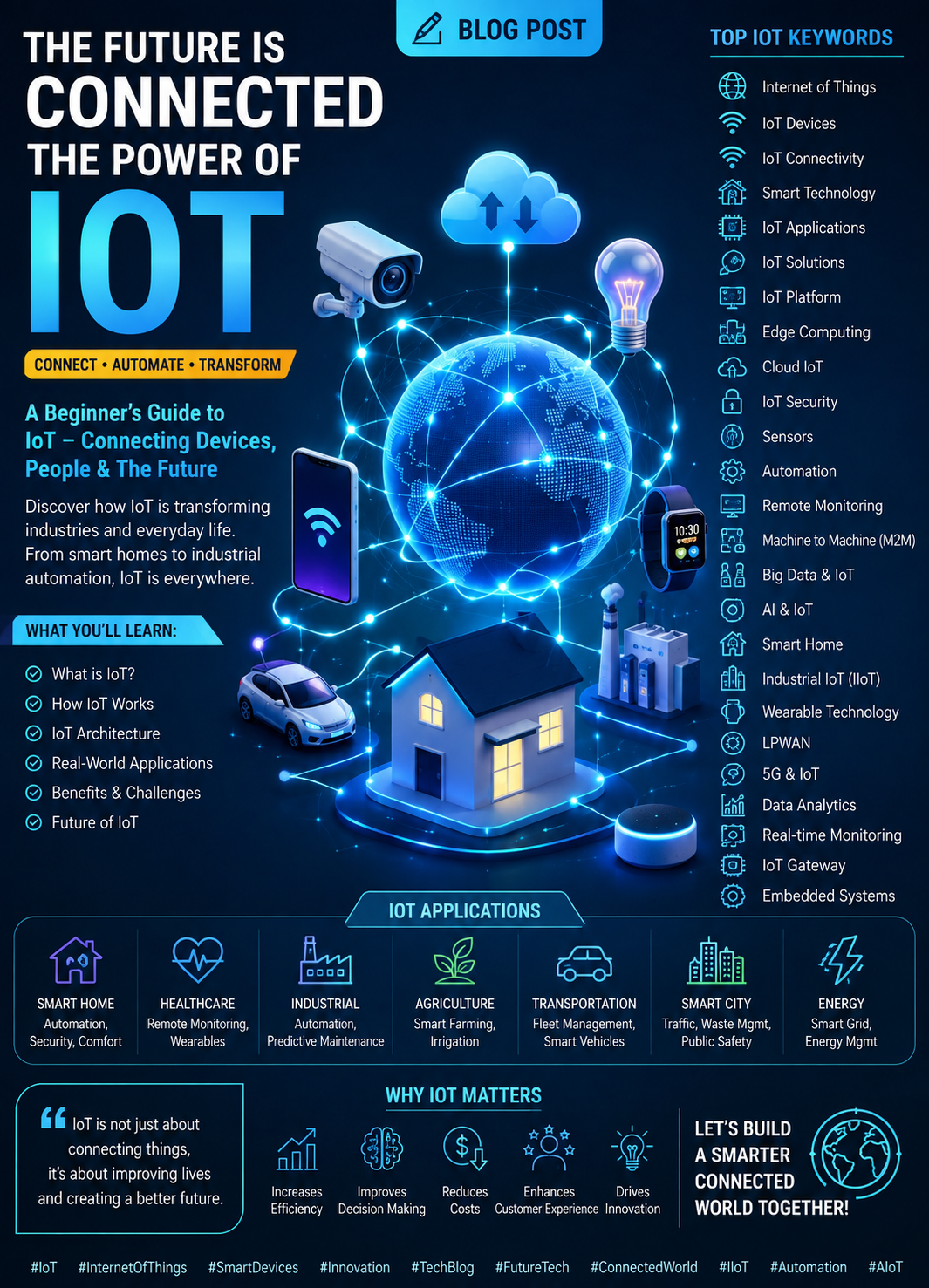
IoT Connect is changing the way people, businesses, machines, and devices communicate. From smart homes and connected cars to industrial automation, healthcare, agriculture, smart cities, and energy management, the Internet of Things (IoT) is becoming one of the most important technologies shaping the future.
But what exactly is IoT, how does IoT connectivity work, and why are businesses investing heavily in connected devices and smart technology?
What Is IoT?
The Internet of Things (IoT) refers to a network of physical devices that can collect, exchange, and process data through the internet or other communication networks.
These devices can include:
- IoT sensors
- Smart home devices
- Security cameras
- Smart watches and wearables
- Connected vehicles
- Industrial machines
- Smart meters
- Medical devices
- GPS tracking systems
- Agricultural sensors
- Smart appliances
Through IoT connectivity, these devices can communicate with applications, cloud platforms, edge computing systems, and other connected devices.
How Does IoT Connect Devices?
An IoT ecosystem normally consists of several important components:
Sensors → Connectivity → IoT Gateway → Cloud/Edge Computing → Data Analytics → Application
Sensors collect information from the physical environment. Connectivity technologies such as Wi-Fi, Bluetooth, 4G, 5G, LoRaWAN, NB-IoT, and Ethernet transmit the information.
The data can then be processed using cloud computing or edge computing, allowing businesses and users to monitor devices, automate processes, and make better decisions.
IoT Connectivity Technologies
Different IoT applications require different connectivity solutions.
Wi-Fi IoT
Wi-Fi is commonly used for smart homes, security cameras, smart appliances, offices, and connected consumer devices.
Bluetooth and Bluetooth Low Energy
Bluetooth and BLE are useful for wearable technology, healthcare devices, smart locks, sensors, and short-range IoT applications.
4G and 5G IoT
Cellular connectivity enables IoT devices to operate over large geographical areas. 5G IoT can provide high-speed, low-latency connectivity for advanced applications such as connected vehicles, smart cities, robotics, and industrial automation.
LoRaWAN
LoRaWAN is designed for low-power, long-range IoT communication. It is particularly useful for smart agriculture, environmental monitoring, smart metering, asset tracking, and smart cities.
NB-IoT
Narrowband IoT (NB-IoT) is designed for low-power connected devices that need reliable cellular connectivity and long battery life.
IoT Applications in the Real World
IoT technology is already being used across many industries.
Smart Homes
IoT enables homeowners to connect:
- Smart lights
- Smart locks
- Smart thermostats
- Security cameras
- Motion sensors
- Smart sockets
- Door sensors
- Home alarms
Users can monitor and control these devices remotely using smartphones and cloud-based applications.
Industrial IoT
Industrial IoT (IIoT) connects industrial equipment, sensors, machines, and production systems.
Businesses can use IIoT for:
- Predictive maintenance
- Machine monitoring
- Production automation
- Asset tracking
- Energy monitoring
- Equipment diagnostics
- Real-time analytics
This can help organizations improve operational efficiency and reduce unexpected equipment failures.
IoT in Agriculture
Smart agriculture uses IoT sensors to monitor soil moisture, temperature, humidity, weather conditions, water usage, and crop conditions.
IoT-enabled irrigation systems can automatically deliver water when required, helping farmers improve productivity while reducing water waste.
Healthcare IoT
IoT healthcare solutions can connect medical devices and wearable technology for remote patient monitoring, health tracking, asset management, and real-time data collection.
Connected Vehicles
Connected car technology combines IoT, GPS, sensors, mobile connectivity, and cloud computing to provide vehicle tracking, fleet management, diagnostics, navigation, and smart transportation services.
IoT Security: Why It Matters
As more devices become connected, IoT security becomes increasingly important.
IoT networks can contain thousands or even millions of connected devices. Weak passwords, outdated firmware, insecure networks, and poorly protected APIs can create security risks.
Important IoT security practices include:
- Strong authentication
- Device encryption
- Secure firmware updates
- Network segmentation
- Access control
- Secure APIs
- Continuous monitoring
- Data encryption
- Regular vulnerability testing
Security should be considered from the beginning when designing an IoT solution.
The Role of AI and IoT
The combination of Artificial Intelligence (AI) and IoT, often called AIoT, is creating even smarter connected systems.
IoT devices collect data while AI can analyze that data and identify patterns.
For example, an industrial machine could use sensors to collect vibration and temperature data. AI algorithms could analyze the information and identify signs of possible equipment failure before the machine breaks down.
This combination creates opportunities for predictive analytics, intelligent automation, predictive maintenance, smart security, and real-time decision making.
The Future of IoT Connect
The future of IoT will involve more connected devices, faster networks, advanced sensors, edge computing, artificial intelligence, automation, and intelligent data analytics.
Technologies such as 5G, edge computing, AI, digital twins, smart cities, industrial automation, robotics, connected vehicles, and smart energy systems will continue to expand the IoT ecosystem.
The goal is not simply to connect more devices.
The real opportunity is to create intelligent systems that can understand data, automate processes, improve efficiency, reduce costs, and solve real-world problems.
Final Thoughts
IoT Connect represents more than just connecting devices to the internet. It represents a connected ecosystem where devices, sensors, machines, software, people, and data work together.
Whether you are interested in smart homes, IoT security, industrial IoT, smart agriculture, healthcare IoT, connected vehicles, IoT platforms, cloud computing, edge computing, AIoT, or smart cities, IoT is creating new opportunities for innovation.
The future is connected—and the businesses and innovators who learn how to use IoT effectively will be in a strong position to build the next generation of smart technology.
